

01
Where it comes from
The hōō is an imagined bird from old Chinese legend, said to appear only when the world is at peace under a wise ruler. In its name, 鳳 is the male and 凰 the female. It was said to rest only in the paulownia tree and to eat only bamboo seeds, and so it is often drawn with paulownia and bamboo. With its long, flowing tail feathers, it has been drawn as one of the most splendid of the auspicious birds.
02
On the cloth
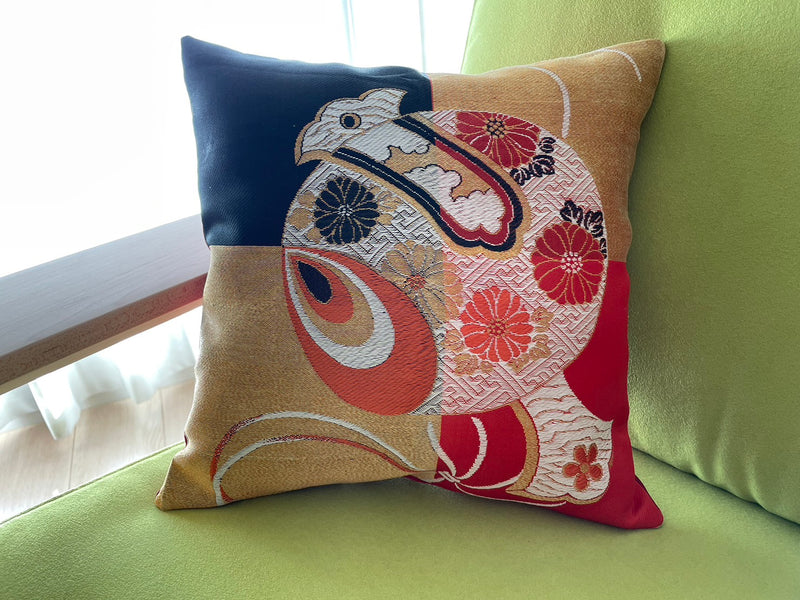
On obi, the phoenix may spread across the cloth with its tail streaming, or circle inside a roundel. Here it appears on a cover of four panels in black, gold, and red; and on green, a phoenix carries a small branch in its beak, in vermilion and gold.

03
To give
The phoenix is a gift for weddings and great celebrations. It suits someone stepping into a new role, or two people beginning a life together.
A word to keep
桐竹鳳凰
kiri take hōō
Paulownia, bamboo, and phoenix: a pattern name for the bird drawn with the tree it rests in and the bamboo it feeds on.
From our cloth
Two questions
What does the Phoenix (鳳凰) pattern mean?
A wish to rise high, into bright and open skies. The phoenix is a gift for weddings and great celebrations.
Where does the 鳳凰 pattern come from?
The hōō is an imagined bird from old Chinese legend, said to appear only when the world is at peace under a wise ruler. In its name, 鳳 is the male and 凰 the female.
